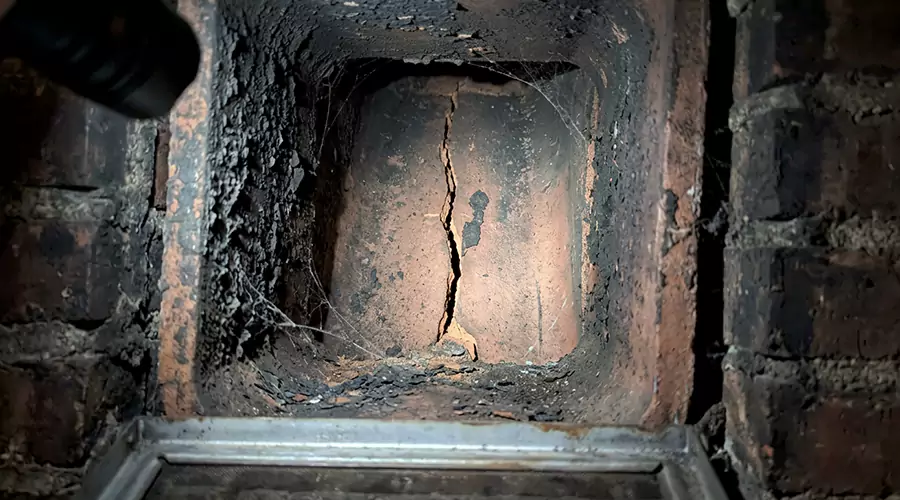
How to Fix Cracks in a Chimney Flue
Discover chimney flue crack causes, warning signs, repair methods, liner replacement costs, and why internal video inspections matter before use.




Based on 500+ Reviews

Proudly American
Owned & Operated

Cracks in a chimney flue should be treated as a safety problem, not just a cosmetic defect. The flue liner helps contain heat, smoke, and combustion gases as they travel out of the home. Small isolated defects may sometimes be repaired, while widespread cracking usually calls for resurfacing or a new liner. A proper chimney inspection should come before any repair to identify the extent of the damage and determine the appropriate solution.
Most masonry flues are lined with clay tiles that face repeated heating and cooling. Over time, those temperature changes can stress the liner and mortar joints.
Common causes include:
A chimney fire can cause severe damage because the liner may be heated far beyond normal operating temperatures. Internal video inspection after a chimney fire is used to look for cracked tiles and failed mortar joints.
Damage inside a flue is often difficult to see from the fireplace opening. Some symptoms are indirect.
Watch for:
A cracked flue liner may not create an obvious exterior crack. This is why internal inspection matters when damage is suspected.
You can perform a limited visual check when the fireplace is completely cold.
Use a flashlight to look upward for loose tile pieces, missing mortar, or obvious openings. Check the bottom of the fireplace for fragments that may have fallen from above.
Do not assume that a clear view of the first few feet means the entire flue is sound. Most of the liner is hidden inside the chimney.
A video inspection is commonly used when concealed damage is suspected because a camera can examine joints and liner surfaces throughout the flue.
Small localized defects may sometimes be repaired when the surrounding liner remains structurally sound.
| Damage | Typical Repair Approach |
|---|---|
| Small mortar-joint gap | Refractory mortar repair |
| Isolated cracked tile | Tile replacement where accessible |
| Minor surface cracking | Approved liner resurfacing |
| Multiple cracks | Full or partial resurfacing |
| Extensive liner failure | New chimney liner |
Individual clay tiles can sometimes be replaced, although reaching the damaged area may require opening part of the chimney wall. Minor mortar defects may also be repaired with high-temperature refractory material.
A cracked flue repair should use a product designed for chimney-liner temperatures. Ordinary household caulk or general masonry filler is not appropriate inside an active flue.
Resurfacing may be considered when the existing liner is largely intact but has multiple small cracks, gaps, or deteriorated joints.
A refractory coating is applied to the interior to create a more continuous surface. This can address defects that are difficult to reach individually.
Large missing tile sections, severe displacement, or major structural damage may make a new liner more practical.
Relining becomes more likely when the existing liner can no longer provide a continuous protective passage.
A new stainless steel, cast-in-place, or other approved liner may be installed depending on the chimney and appliance.
Relining may be recommended when:
Professional chimney liner installation commonly costs about $1,500 to $5,000 in 2026, with many projects around $2,500.
Chimney flue repair cost varies widely because a small tile problem is very different from replacing an entire liner.
| Repair Type | Typical 2026 Cost |
|---|---|
| Limited flue repair | $200 to $850 |
| Cracked flue tiles | $250 to $1,000 |
| Flue tile repair | $65 to $100 per sq. ft. |
| Flue resurfacing | About $2,000 to $3,500 |
| Chimney liner replacement | About $1,500 to $7,000 |
Current 2026 pricing shows that limited flue repairs can remain below $1,000, while resurfacing or complete liner replacement can cost several thousand dollars.
The final cost depends on chimney height, access, liner material, and whether masonry must be opened to reach damaged tiles.
It is safer not to use a fireplace or connected appliance when a damaged flue liner is suspected.
The liner is intended to contain combustion products and limit heat exposure to surrounding chimney materials. Open cracks or failed joints can compromise that barrier.
This is especially important after a chimney fire. An internal video inspection should verify the condition of the tiles and mortar joints before normal use resumes.
Do not light a test fire to see whether a suspected crack leaks smoke.
Professional inspection is appropriate whenever damage appears to involve the liner.
Arrange an evaluation when:
A camera inspection can determine whether a localized repair is reasonable or whether the liner needs resurfacing or replacement.
Have the chimney inspected regularly and address creosote before it becomes heavy. Keep the cap, crown, and flashing in good condition so water does not enter the chimney structure.
Use the fireplace or stove according to its operating requirements. Avoid inappropriate fuels or excessively hot fires.
If a chimney fire occurs, stop using the system until the liner has been inspected internally.
The correct way to fix cracks in a chimney flue depends on how much of the liner is damaged. Small mortar gaps or isolated tile defects may be repairable, while widespread cracking often requires resurfacing or complete relining.
Because much of the flue is hidden, start with an internal video inspection instead of choosing a repair based only on what is visible from the firebox.
Yes. Small localized cracks or mortar-joint defects may be repaired when the rest of the liner remains sound.
Repairs may use high-temperature refractory mortar or an approved flue-resurfacing system, depending on the damage.
Cracked flue tile repairs commonly cost about $250 to $1,000 in 2026, while extensive relining costs considerably more.
Not always. Isolated defects may be repairable, but multiple cracks or widespread deterioration can make a new liner the better solution.
A repair material must be specifically suitable for chimney-liner temperatures. Improvised surface patches should not replace a proper inspection.
A video camera can be moved through the flue to inspect tile surfaces, mortar joints, gaps, and other concealed damage.
Discover chimney flue crack causes, warning signs, repair methods, liner replacement costs, and why internal video inspections matter before use.
